
For many Canadians, audio now belongs to the structure of the day itself. It fills the gap during a commute, adds shape to a walk after supper, and makes kitchen time feel more focused. That is why long-form podcasts are now often chosen over radio left to play whatever comes next.
Radio, however, still carries real value. It remains a dependable source for traffic, weather, local information, and emergency updates in both urban and regional settings. Podcasts differ in one important way, since listeners can choose the exact subject and the amount of listening time in advance.
Why Canadian Listeners Want More Control Over What They Hear
One word explains much of this shift: control. A listener can press play on a 40-minute interview and let it carry through a Toronto ride or a quiet walk in Calgary. Radio feels less steady, since one hour can move through music, ad breaks, promos, and short talk without much warning.
The contrast is especially visible in Canada because radio still has real scale. CBC/Radio-Canada alone operated 88 radio stations, along with 27 television stations and one digital-only station, as of February 2024. Even so, selective listening has become a larger part of everyday life, while passive listening now sits further in the background.
This pattern also affects trust. A regular host who returns every week can become familiar in a way that short radio talk rarely matches. For useful context on that larger media setting, readers can look at the Canadian broadcasting system.
Before this shift stood out, radio was often something people switched on and left alone. Now the pattern is different, since listeners usually make a choice first based on what they are doing or how long they have. In that sense, podcasts feel more deliberate and more closely matched to real routines.
Before the list below, one point matters most. Podcast listening usually starts with a plan, even if that plan is simple. That is why the format works so well in ordinary routines:
- listeners choose the exact topic or genre before starting;
- episodes often run 30 to 60 minutes or more;
- hosts return on a set schedule, which builds familiarity;
- playback can pause, skip, or resume at any minute.
Together, these factors show why podcasts often suit solo time so well. The listener begins with a clear idea of the tone, topic, and pace of the next half hour. That level of certainty is one of the key reasons long-form audio continues to expand.
How Online Casino Bonus Research Fits Into Modern Audio Habits
The same habit of careful choice appears in other parts of online leisure. Some adults do not move from one random site to another anymore, because they compare options first and then decide where to spend their time. In that setting, a few users also browse bonus options before picking an online casino offer for the evening.
That does not turn a podcast listener into a casino-focused user. Instead, it shows a wider pattern, since many people now compare time, cost, and clarity before they click anywhere. A site CasinosAnalyzer can serve as a quick reference point, much like a podcast app helps narrow audio choices in advance.
For some users, this means evening media habits are split more clearly by purpose. A podcast may be appropriate for a commute, a walk, or housekeeping, whereas online casino research may require a distinct session later in the evening. In both circumstances, the decision is more intentional than passive.
Why Podcasts Fit Commuting, Chores, and Solo Routines So Well
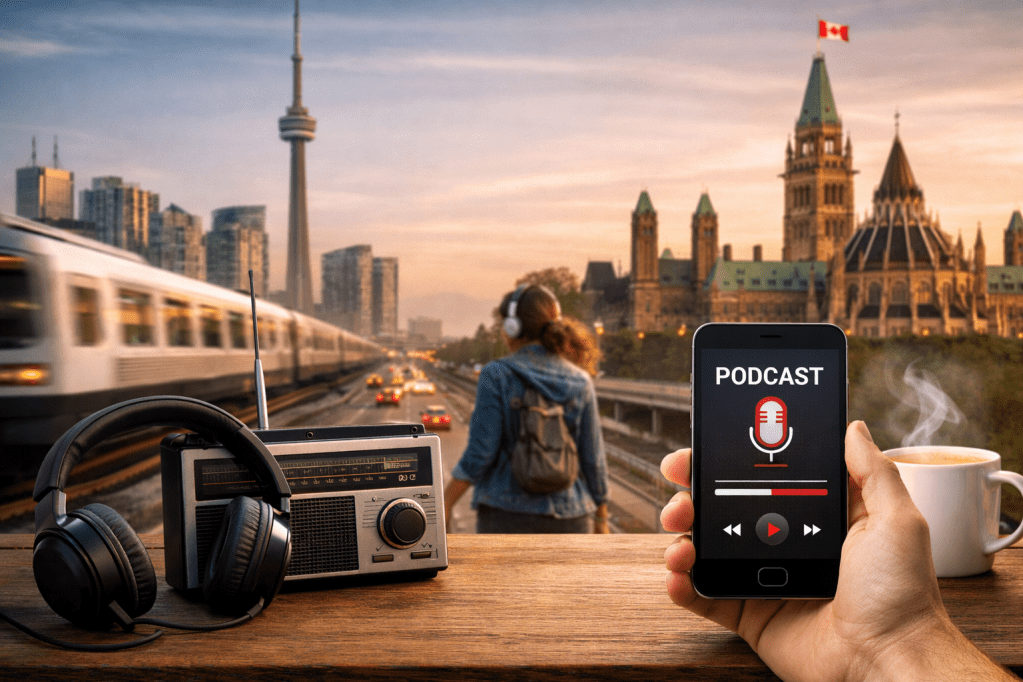
Podcasts work well when screens are not practical. A listener can start one episode while making dinner in Edmonton, walking through downtown Ottawa, or driving between Hamilton and Niagara. In each case, the audio fills the time without asking for full visual attention. That makes the format especially useful in parts of the day when reading, watching, or typing would be inconvenient.
That difference has more impact than it may seem. A 35-minute music set can match the length of a commute quite closely, while a 50-minute discussion can cover a full round of chores at home. Because podcasts are arranged as complete episodes, they often suit real-life timing better than radio’s continuous stream. The result is a listening session with a clearer opening, middle, and finish.
Everyday Situations Where Long-Form Audio Works Best
The examples that follow show how this fit plays out in practice. Each one is based on an ordinary moment rather than a special event. Simply put, podcasts do not succeed because people clear new space for them, but because they work within time that already exists. For that reason, long-form podcasts continue to spread through daily life:
- A 35-minute SkyTrain ride across Metro Vancouver.
- A grocery trip followed by cooking at home.
- A solo walk after 8 p.m. in a residential area.
- A highway drive between Ottawa and Kingston.
These examples show why length matters. One complete discussion can begin and end inside one practical block of time. As a result, the listener does not need to search for the next segment or wait for the topic to return. Radio can still fill that same hour, but it often breaks the flow before the listener reaches a full idea.
What Makes Long-Form Podcasts Feel More Useful Than Radio Segments
A strong podcast episode usually has shape. It opens with a question, adds background, brings in names or dates, and then closes with one clear point. That structure helps the listener stay with the subject from start to finish, especially during quiet solo time.
Canadian examples make this easy to see. Historica Canada’s Residential Schools was released as a three-part series, while Strong and Free was released as a six-part series. In both cases, the listener gets a planned sequence rather than a few short fragments dropped between other programming.
That planned format also helps with memory. A listener is more likely to remember one complete 45-minute discussion or music set than four scattered radio segments heard between songs and ad breaks. For that reason, podcasts often feel more useful when the goal is depth, not just company in the background.
The same preference for order appears elsewhere online. Readers who compare online casino pages often look for the same thing: clear details, direct terms, and less clutter. So even when the topic changes, the habit behind the click looks very similar.
Why This Shift Says More About Attention Than Technology
In the end, this change is not only about phones or apps. It is about attention, and about how carefully people now use it during the day. Canadians continue to rely on radio for fast local information, but podcasts frequently win when a single topic needs to be covered thoroughly.
For this reason, long-form podcasts continue to replace background radio in daily life. They fit neatly into short errands, gym sessions, and routine tasks around the house. They also suit a wider pattern in which people make more considered choices across digital media, from streaming and newsletters to occasional online casino use.
For many Canadian listeners, that sense of choice is now the key point. They do not only want sound in the room. They want a topic worth following, a host worth hearing, and an hour that feels well spent.





 Music City Drive-in
Leave a comment