
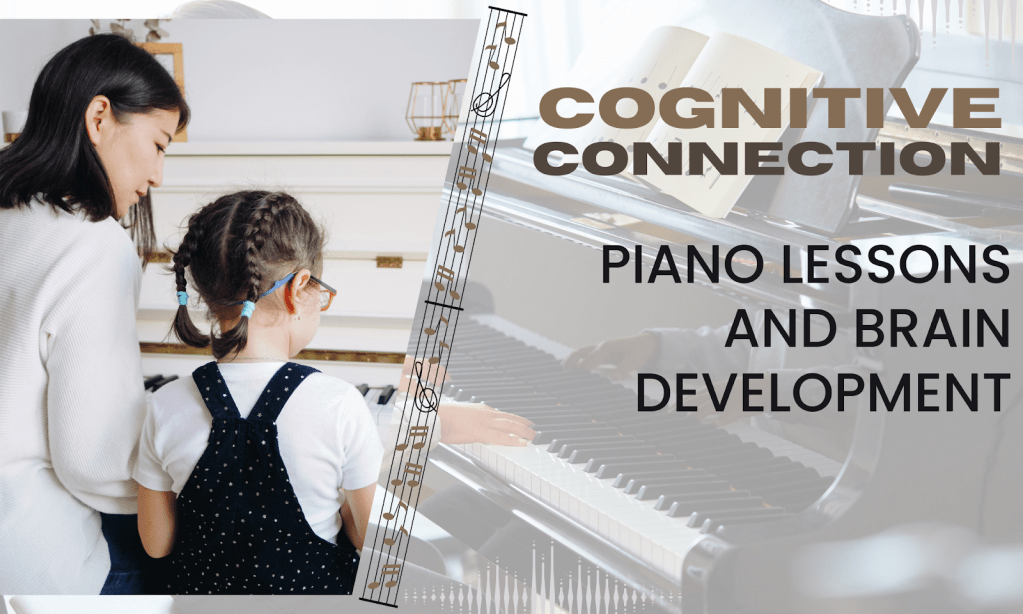
There’s a particular moment every piano teacher knows well when a child’s fingers finally find their rhythm across the keys, and something shifts. The eyes light up, not just with the thrill of making music, but with a deeper confidence that seems to ripple outward into everything else they attempt.
Parents often walk in with very practical questions:
Is piano really worth the time compared to sports or coding classes?
Will it actually help my child, or is it just a hobby?
What they don’t yet realize is that the piano isn’t competing with those activities; it’s laying the neural groundwork that makes all of them easier. This is particularly vital in an era where many teens struggle with pressure and the need for a balanced outlet.
In music rooms across the world, teachers witness quiet transformations.
Shy seven-year-olds grow more comfortable expressing themselves. Kids who once struggled with fractions suddenly “get it” after learning to count rhythms and triplets. Parents notice, sometimes to their surprise, that their child’s focus, patience, and self-discipline improve after just a few months at the keyboard.
Parents report, often with surprise, that their child’s focus and self-discipline have improved dramatically after just a few months at the keyboard.
The piano is more than just a musical instrument.
It’s a comprehensive brain workout that engages almost every area of the central nervous system simultaneously.
This is especially true for families considering a beginner piano lesson in NYC, where schedules are packed and choices feel endless. Each piano lesson is about the brain coordinating memory, movement, listening, emotion, and problem-solving all at once.
And what’s fascinating is that modern neuroscience is now confirming what music teachers have known for generations: learning piano actually changes how a child’s brain develops.
What’s really happens when a child plays piano
Playing the piano looks simple from the outside. Inside the brain, it’s anything but.
In just one minute of playing, a child must:
- Read two lines of music in different clefs
- Turn those symbols into precise finger movements
- Listen closely and adjust timing and pitch in real time
All of this requires constant communication between the left and right sides of the brain. The structure that connects them, called the corpus callosum, becomes stronger and more efficient. This level of coordination is a powerful tool for improving a child’s overall positive well-being. In simple terms, piano practice helps build a faster, better-connected brain.
In simple terms, piano practice helps build a faster, better-connected brain.
While one part of the brain controls fine motor skills, another processes what the eyes see on the page, and another listens for accuracy. This level of coordination doesn’t happen often in other activities. For children and teenagers, whose brains are still developing, this kind of stimulation helps strengthen the pathways they’ll rely on later in school and life.
How piano lessons strengthen memory
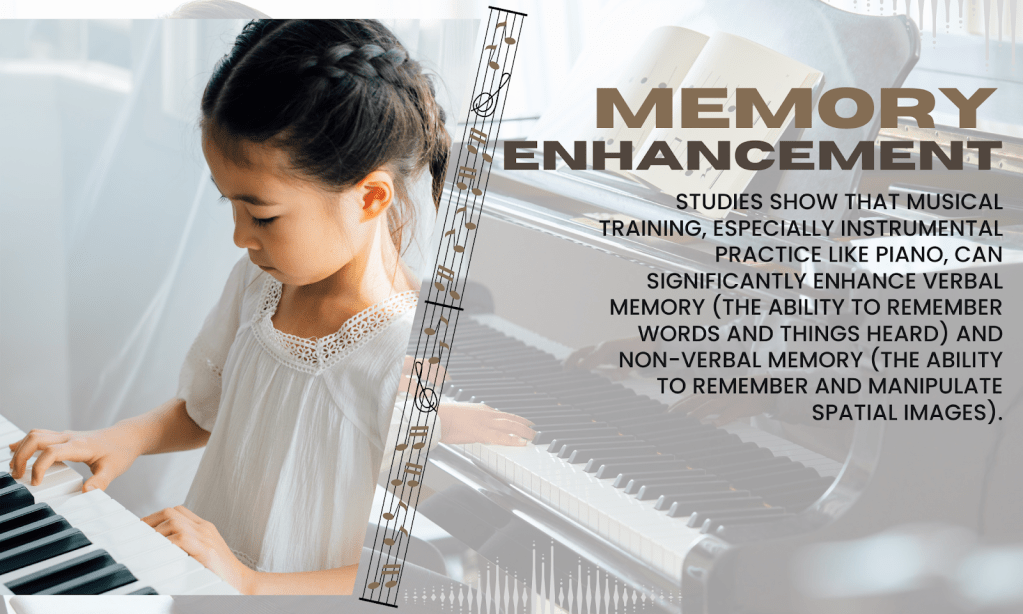
Memory is at the center of learning. Kids need it to follow instructions, remember lessons, and prepare for exams. Piano training supports both working memory and long-term memory in a very natural way.
When learning a new piece, a child is constantly thinking ahead:
- Holding the next rhythm in mind
- Remembering what comes after the current measure
- Gradually memorizing the full piece for performance
But it doesn’t stop at mental memory. Piano also builds muscle memory. The hands remember movements. The ears remember sound. The eyes recognize patterns.
Because children are seeing the notes, hearing the music, and feeling the keys at the same time, the brain stores information in multiple ways.
This makes recall stronger and more flexible. Studies have shown that children with piano training often perform better on memory tasks that have nothing to do with music, like remembering word lists or visual patterns.
These are the same skills needed for learning new languages, science formulas, and complex subjects later on.
How piano helps with math (Yes, really)
This is one of the most common questions parents ask. Music feels creative. Math feels logical. How could they possibly be connected?
The answer lies in patterns and timing. Music is, at its heart, math in motion.
When children learn rhythm, they are constantly working with fractions:
- Two half notes make a whole
- A dotted quarter note lasts longer than a regular one
- Time signatures require steady counting and division
When they practice scales and intervals, they are learning:
- Ratios
- Repeating patterns
- Sequences that build on one another
This isn’t just a nice idea. Research from the University of California found that students who received piano instruction scored higher on tests involving fractions and proportional reasoning than those who did not study music.
As students grow older, these skills deepen. Navigating chord progressions uses the same kind of pattern recognition needed in geometry and algebra. By the time a piano student reaches high school math, their brain is already comfortable working with:
- Variables
- Symbols that change meaning depending on context
- Complex structures built from smaller parts
That mental flexibility is exactly what advanced math and science demand.

This perspective is echoed by Vincent Reina, founder of Music To Your Home, who regularly works with students preparing for long-term academic goals. He notes that music lessons tend to stand out most when they reflect consistency and real achievement over time.
Focus, multitasking, and executive function
Today’s kids are surrounded by distractions. Learning how to focus deeply is harder than ever.
Playing the piano is one of the best exercises for what psychologists call executive function; the ability to plan, focus, and manage multiple tasks at once.
At the piano:
- Each hand may be doing something different
- The feet control pedals
- The eyes scan ahead
- The brain stays alert and organized
Unlike scrolling on a screen, piano practice demands sustained attention. Over time, this skill transfers into schoolwork. Students who learn to manage complex pieces of music are often better at breaking down large projects, staying organized, and working through challenges without shutting down.
Emotional growth, resilience, and confidence
Piano lessons also teach something just as important as academics: resilience.
Learning piano is hard. There’s no shortcut. Progress comes slowly, through repetition and patience.
Children make mistakes, often many times before things finally come together. This builds grit and perseverance in a very real way.
When a child finally performs a piece they’ve worked on for weeks, the confidence they gain is genuine. This is a critical component of building self-esteem in teenagers, who are often navigating social pressure and self-doubt. Turning emotions into sound is a powerful coping skill that can last well into adulthood, providing a healthy alternative to the stress and anxiety many young people face today.
Music also gives kids a healthy emotional outlet. For many teens, the piano becomes a safe space to process stress, frustration, or big feelings without words. Turning emotions into sound is a powerful coping skill that can last well into adulthood.
Supporting your child’s piano journey (without pressure)
The benefits of piano are strongest when the experience feels supportive, not stressful.
A few simple ways parents can help:
- Keep practice short and consistent rather than long and forced
- Let children play music they enjoy, not just what’s assigned
- Celebrate effort and small improvements, not just performances
- Make sure they have a good-quality instrument with weighted keys
When children feel ownership over their learning, they’re far more likely to stick with it; and that’s where the real cognitive benefits come from.
Final Thoughts
Piano lessons offer far more than musical skill. They strengthen memory, support math learning, improve focus, and help children build emotional resilience. Whether your child continues music long-term or not, the brain they develop through piano training becomes a lasting advantage.
It’s one of the few activities that supports academic success, emotional health, and personal confidence all at once. And those benefits stay with them long after the final note fades.


 Music City Drive-in
Leave a comment